


 yueyang@yueyangcz.com
What to use for concrete formwork
 Sep 23, 2025|
 View:1247
Concrete formwork, a temporary structural system essential for shaping and supporting freshly poured concrete, plays a pivotal role in modern construction. It ensures the concrete gains sufficient strength while maintaining the desired geometry, preventing defects such as cracks, uneven surfaces, or structural deformation. The selection of formwork materials and types directly impacts construction quality, cost efficiency, and project timelines. This article explores the primary materials and systems used in concrete formwork, analyzing their advantages, limitations, and applications.
1.Traditional Materials: Wood and Plywood
Wood has been a cornerstone of formwork for centuries due to its availability and ease of fabrication. Timber formwork is particularly suitable for small-scale projects or complex shapes where flexibility is required. However, its susceptibility to warping, swelling, and shrinkage under moisture exposure poses challenges. To mitigate these issues, water-impermeable coatings are applied to enhance durability and facilitate smooth demolding. Despite these drawbacks, timber remains cost-effective for short-term use, though its reusability is limited to 6–7 cycles.
Plywood, a densified wood product with smooth surfaces, has emerged as a superior alternative. Composed of multiple compressed veneers, plywood formwork offers better dimensional stability and resistance to environmental degradation. It is widely used for ceilings, walls, and slabs, providing a clean finish while supporting moderate loads. For instance, in drainage systems or road construction, plywood platforms ensure precise concrete shaping. However, its high-pressure manufacturing process increases costs compared to raw timber, making it less economical for large-scale projects.
2.Steel Formwork: Durability and Precision
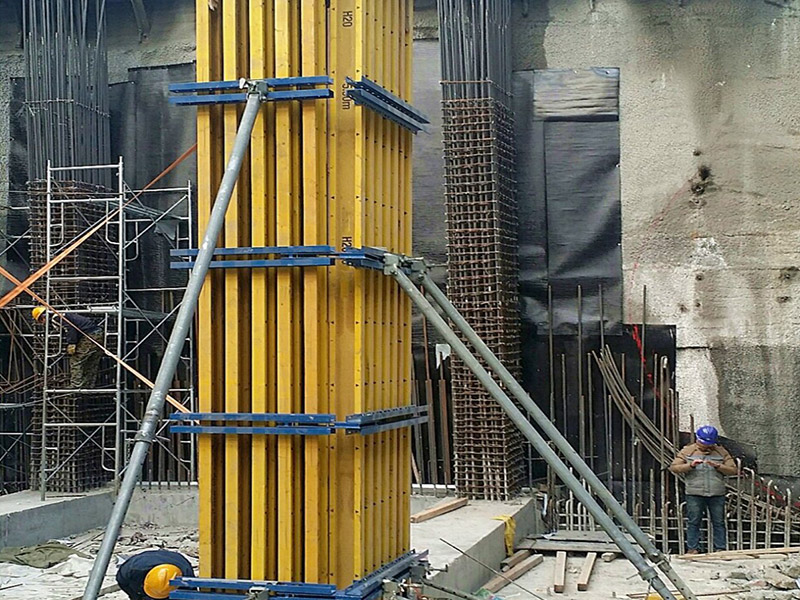
Steel formwork revolutionized the industry by addressing the limitations of wood. Its high rigidity and strength enable it to withstand significant lateral pressures from concrete placement, making it ideal for columns, beams, and high-rise structures. Key advantages include:
Reusability: Steel panels can be reused over 50 times, reducing long-term costs despite higher initial investments.
Surface Finish: Delivers uniform, smooth concrete surfaces with minimal finishing work.
Structural Integrity: Minimizes concrete shrinkage and distortion, ensuring accurate replication of complex geometries, such as curved edges or intricate architectural details.
For example, in bridge construction, steel formwork maintains stability under heavy loads and dynamic forces, while its modular design allows rapid assembly and disassembly. However, steel’s weight necessitates robust support systems, increasing labor and equipment costs. Additionally, corrosion resistance requires protective coatings in humid environments.

3.Aluminum Formwork: Lightweight and Sustainable
Aluminum formwork combines the benefits of steel and wood, offering a lightweight yet durable solution. Its low density reduces transportation and handling costs, while its corrosion resistance ensures longevity in harsh conditions. Advantages include:
Environmental Sustainability: Aluminum is 100% recyclable, aligning with green construction practices.
Precision: Enables tight tolerances, with dimensional variations kept to a minimum (≤3mm/m).
Efficiency: Pre-fabricated panels accelerate installation, supporting rapid-cycle construction methods like daily floor casting in high-rise projects.
A notable application is in residential towers, where aluminum formwork achieves consistent surface quality while reducing waste and debris. However, its higher material cost compared to steel or wood limits its use to projects prioritizing speed and sustainability over budget constraints.
4.Innovative Systems: Hydraulic and Fabric Formwork
Technological advancements have introduced specialized formwork systems. Hydraulic automatic climbing formwork, for instance, integrates mechanical lifting mechanisms to support core tube structures in skyscrapers, handling loads up to 5 tons per unit. Fabric formwork, made from high-strength textiles, offers flexibility for organic shapes like freeform shells or curved facades, though it requires precise tensioning to prevent deformation.
Need Custom Scaffolding & Construction Equipment Solutions For Your Projects?
Changzhou Yueyang Machinery specializes in full-range Ringlock Scaffolding, Frame Scaffolding, Formwork, Safety Barrier & Accessory systems for construction, stage event, mining and heavy industry. ISO 9001 certified, comply with EU EN & Australia AS/NZ safety standards. Factory direct one-stop service from drawing customization to full container delivery.
Conclusion: The Future of Concrete Formwork
The evolution of concrete formwork reflects a balance between material innovation and cost-effectiveness. Traditional materials like wood and plywood remain relevant for small-scale or temporary structures, while steel and aluminum dominate high-stakes projects demanding precision and reusability. Emerging systems, such as hydraulic and fabric formwork, push the boundaries of architectural design, enabling complex geometries once deemed impractical. As construction trends prioritize sustainability, modularization, and automation, the role of concrete formwork will continue to evolve, ensuring it remains indispensable in shaping the built environment. By selecting the appropriate formwork based on project requirements, engineers and contractors can optimize quality, safety, and efficiency, reinforcing concrete formwork’s status as a cornerstone of modern infrastructure development.